C1 flutter & upper-neck instability
The top vertebra should glide smoothly. When it quivers, bounces, or doesn't move in rhythm with the skull and C2, it points to instability at the most sensitive joint in your spine.
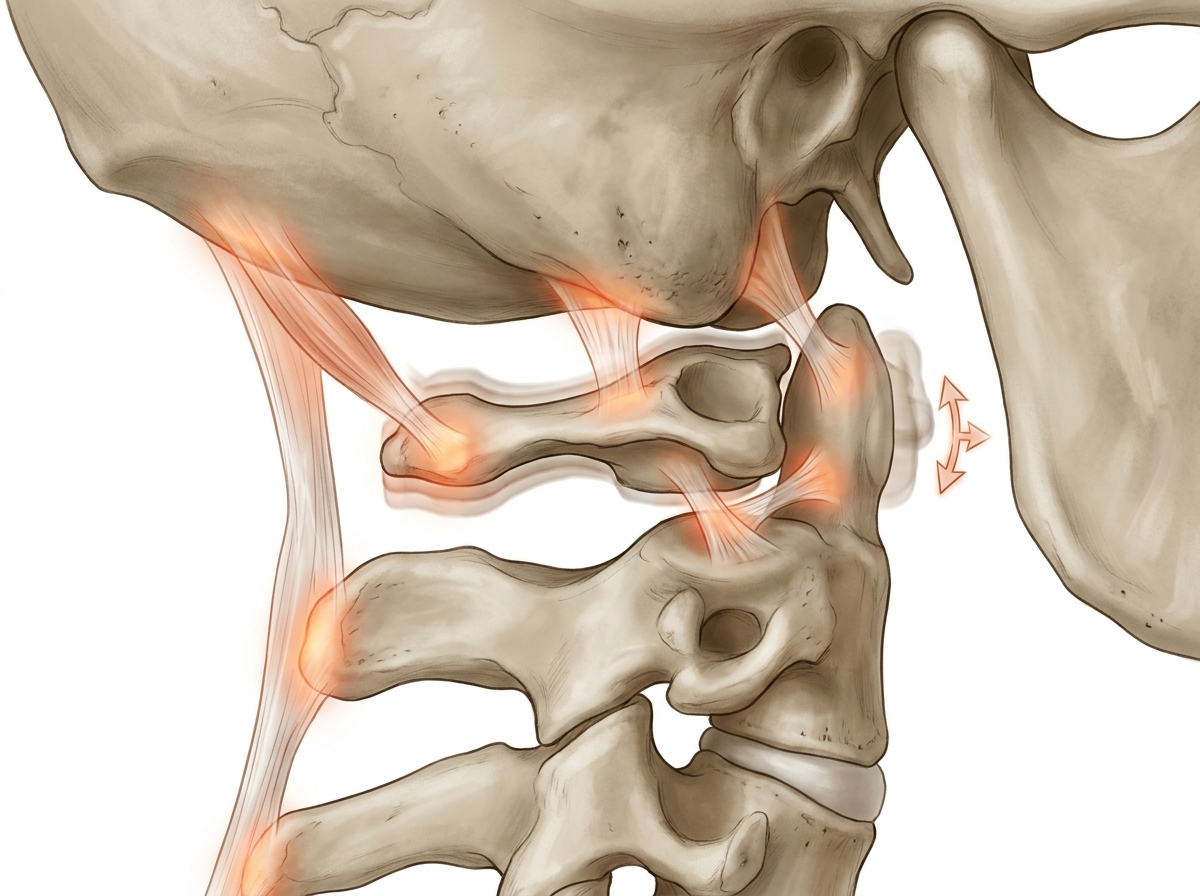
Illustration for education. Proprietary DMXRays anatomy — clinician-reviewed set in progress.
What we're looking at
C1 (the atlas) is the ring-shaped bone your skull sits on. It's held in precise position by strong ligaments so your head can nod and turn smoothly. On a Digital Motion X-Ray, a healthy C1 glides. An unstable one 'flutters' — it bounces or quivers instead of moving smoothly, especially as you jut your chin and move through flexion and extension.
What's going wrong underneath
When the deep stabilizers and ligaments at the top of the neck can't hold C1 steady, the small muscle that connects the back of C1 to the skull and the ligament running down the back of the neck are repeatedly stressed. Because this junction is so rich in position-sensors, that instability doesn't just cause pain — it can scramble your sense of balance and head position.
Why it's a big deal
This is the junction between your head and spine — the area most tied to dizziness, balance, and that 'nervous-system on edge' feeling. Catching instability here, and watching whether treatment settles it down, is one of the most valuable things motion imaging does.
Symptoms it can cause
This is exactly what a Digital Motion X-Ray reveals.
A still X-ray is one frozen moment. DMX films your neck moving — so the affected level shows itself. Ask your provider about a Digital Motion X-Ray, or find a clinic that uses DMXRays.
Related
Educational and informational only — not medical advice or a diagnosis. Imaging must be interpreted by a licensed clinician. Powered by doctorhutcheson.com.