When symptoms appear 'out of nowhere'
Sometimes there's no accident to point to — the neck simply reaches a tipping point. Here's why symptoms can seem to arrive spontaneously.
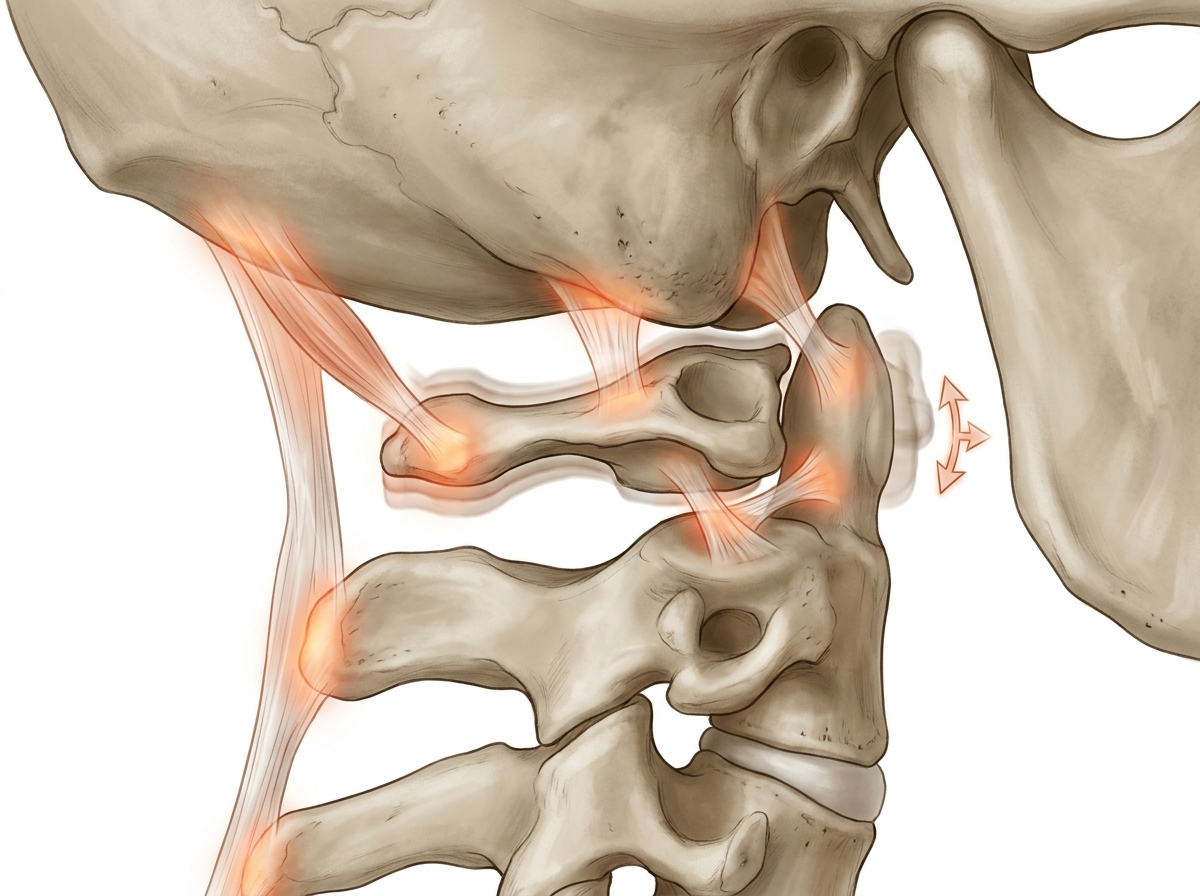
Illustration for education. Proprietary DMXRays anatomy — clinician-reviewed set in progress.
It rarely comes from nowhere
When symptoms seem to appear overnight, there's usually a long, quiet build-up behind them (see repetitive microtrauma). The structures were compensating for months or years — and then one ordinary movement, a bad night's sleep, or a stressful week pushes them past what they can absorb. The symptom is sudden; the cause was not.
The nervous-system connection
The upper neck is packed with sensors that tell your brain where your head is in space. When the top joints don't move smoothly, those sensors send confusing signals — and that can show up as dizziness, imbalance, a foggy head, or feeling 'off' in ways that seem unrelated to your neck. That mismatch is often why people feel unwell without an obvious reason.
Why motion imaging helps
Because the trigger was subtle, standard imaging taken at rest often looks 'fine.' Watching the neck move is what reveals the level that finally gave way.
Symptoms it can cause
This is exactly what a Digital Motion X-Ray reveals.
A still X-ray is one frozen moment. DMX films your neck moving — so the affected level shows itself. Ask your provider about a Digital Motion X-Ray, or find a clinic that uses DMXRays.
Related
Educational and informational only — not medical advice or a diagnosis. Imaging must be interpreted by a licensed clinician. Powered by doctorhutcheson.com.