Repetitive microtrauma: the injury that builds up quietly
You don't need one big accident. Thousands of small over-stresses — posture, phones, old habits — can strain the same structures a little at a time until they fail.
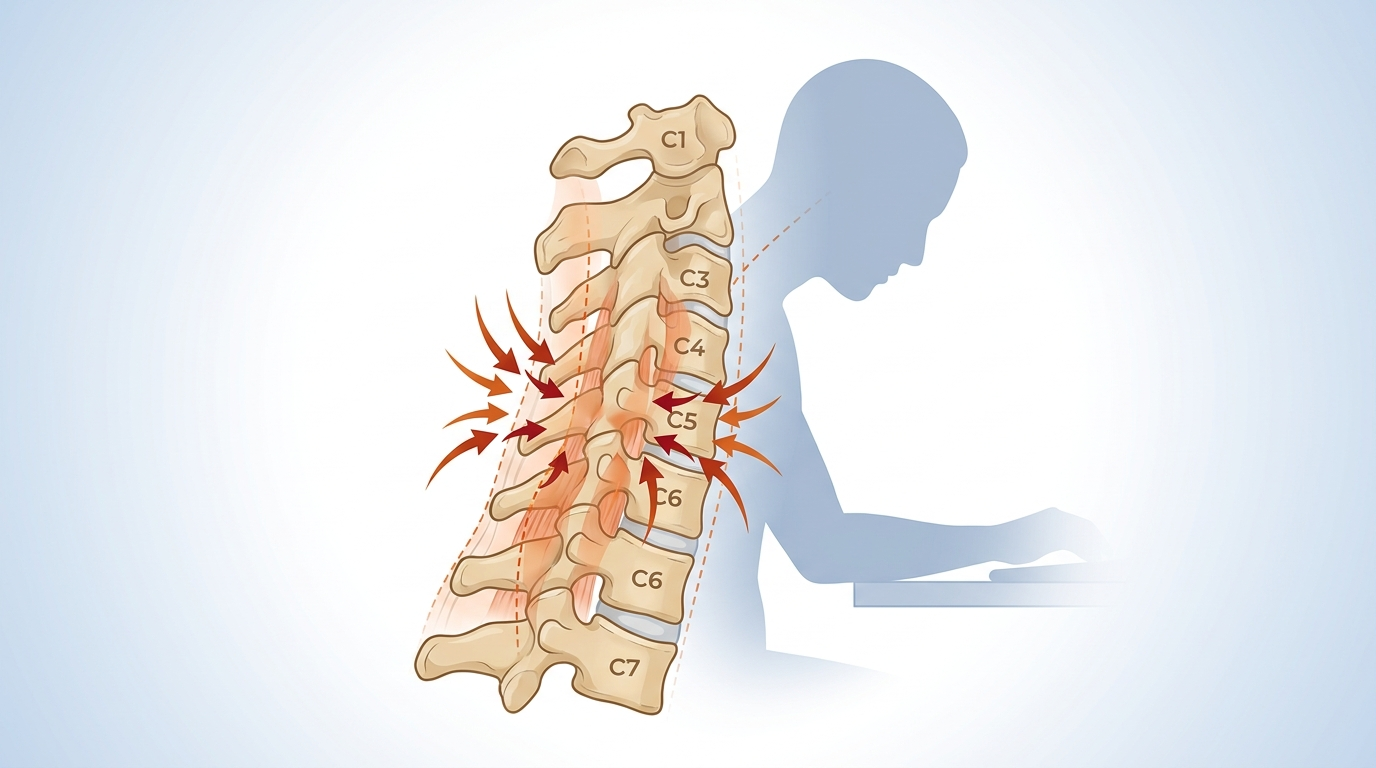
Illustration for education. Proprietary DMXRays anatomy — clinician-reviewed set in progress.
Small forces, repeated, add up
Every time a joint moves a little more than it should, the ligaments and tendons that hold it take a tiny bit of strain. One time is nothing. But repeat that thousands of times — hours on a phone, a forward-head posture, a level that's slightly loose — and those tiny strains accumulate into real, measurable injury. This is why some people have significant findings with no memory of ever being hurt.
What actually gets damaged
The connective tissues take the hit first. Ligaments that are repeatedly over-stretched develop micro-tears and slowly lose their ability to hold a joint tight. The tendons and deep muscles that try to compensate get overworked and strained. Over time a level that should move a precise few millimeters starts moving too much — and that extra motion is what we see on a Digital Motion X-Ray.
Why it matters that we can measure it
Because it built up slowly and invisibly, this kind of injury is easy to dismiss — until it's advanced. Seeing the actual motion, level by level, lets your clinician catch it earlier and track whether treatment is turning it around.
Symptoms it can cause
This is exactly what a Digital Motion X-Ray reveals.
A still X-ray is one frozen moment. DMX films your neck moving — so the affected level shows itself. Ask your provider about a Digital Motion X-Ray, or find a clinic that uses DMXRays.
Related
Educational and informational only — not medical advice or a diagnosis. Imaging must be interpreted by a licensed clinician. Powered by doctorhutcheson.com.