Anterolisthesis / hypermobility (a level that slips)
When one vertebra slides too far forward on the one below as you move, it's a sign the ligaments that should hold it steady have been stretched or injured.
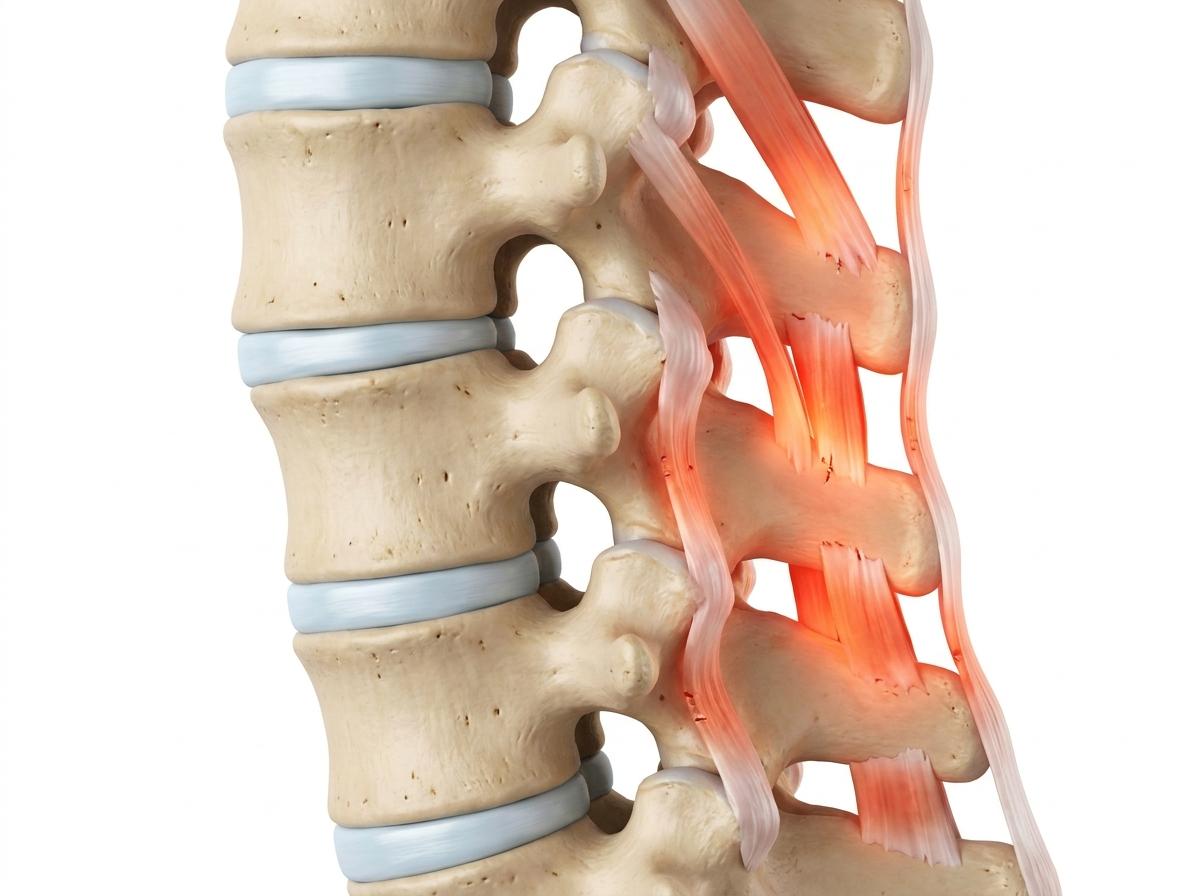
Illustration for education. Proprietary DMXRays anatomy — clinician-reviewed set in progress.
What we're looking at
As you bend your neck forward, each vertebra should glide only a precise few millimeters over the one below. When one slides too far — what we call anterolisthesis or hypermobility — it means the ligaments that normally act as that level's seatbelt have loosened. On a still X-ray held in one position this can hide; in motion, it reveals itself.
What's being strained
As the vertebra slips and the spinous processes separate, the ligaments running between and along them are pulled taut and can develop micro-tears at their attachment points. The deep muscles that try to stabilize the level get overworked. A little extra motion, repeated all day, becomes ongoing irritation.
Why motion matters here
This is the textbook example of an injury a still X-ray misses and a motion study catches. It's also very trackable — the exact millimeters can be followed over time to see if care is helping.
Symptoms it can cause
This is exactly what a Digital Motion X-Ray reveals.
A still X-ray is one frozen moment. DMX films your neck moving — so the affected level shows itself. Ask your provider about a Digital Motion X-Ray, or find a clinic that uses DMXRays.
Related
Educational and informational only — not medical advice or a diagnosis. Imaging must be interpreted by a licensed clinician. Powered by doctorhutcheson.com.