Whiplash: what actually happens to your neck
A sudden force whips the head back and forth faster than the muscles can brace — and the damage depends on the direction, the speed, and the shape your neck was already in.
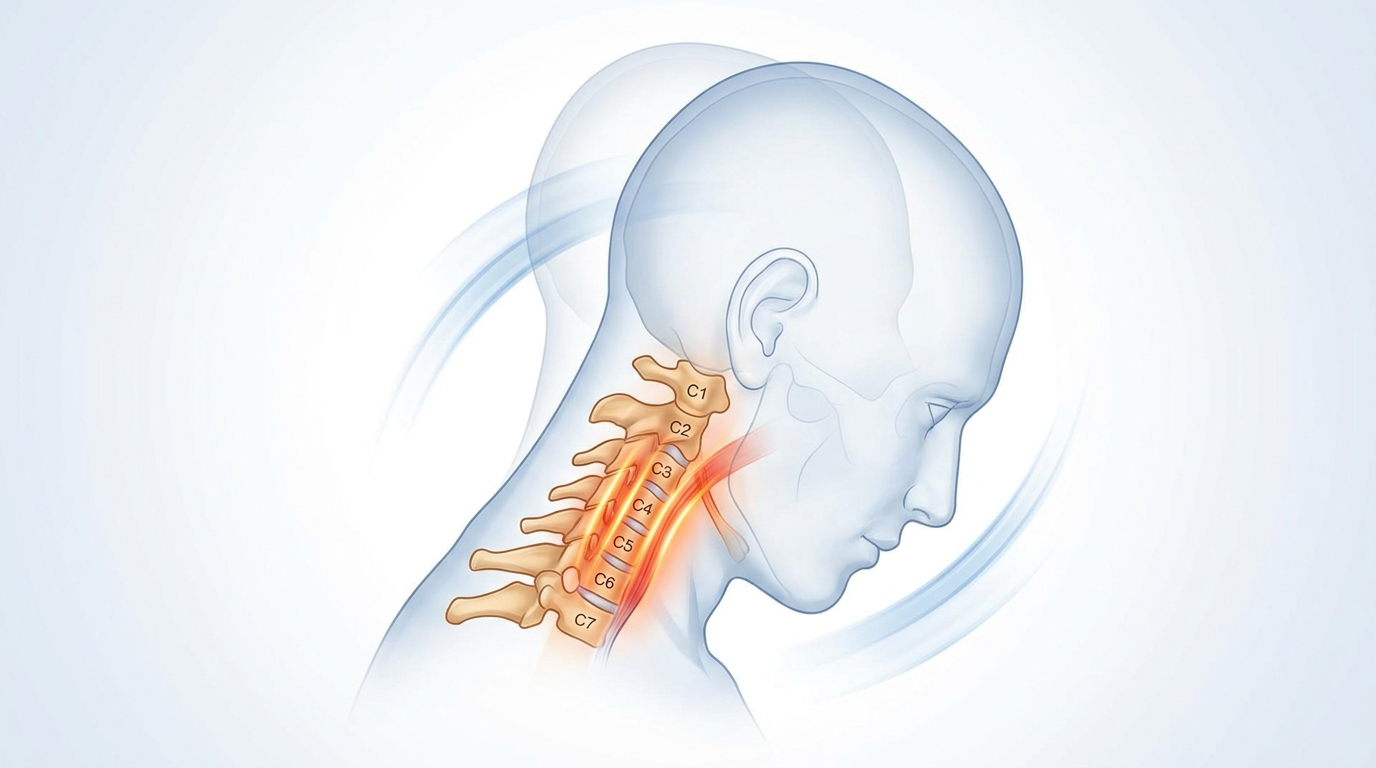
Illustration for education. Proprietary DMXRays anatomy — clinician-reviewed set in progress.
What whiplash really is
Whiplash isn't one injury — it's what happens when your head gets thrown in a direction faster than your neck muscles can react. In the fraction of a second before your muscles catch up, the ligaments and joints of the neck are asked to absorb force they were never designed to take. That's the moment the damage happens.
Why the direction of the hit matters
A rear impact, a side impact, and a front impact each stress different structures. In a rear-end collision the head is first thrown backward (extension), which can jam the small facet joints and over-stretch the front of the neck; then it rebounds forward (flexion), straining the ligaments and muscles at the back. Side and angled impacts add a twisting, tilting load that the neck tolerates even less.
Why the shape your neck was already in changes everything
Two people in the same crash can walk away with very different injuries. If your neck already had a straightened or reversed curve, poor posture, or old stiffness at some levels, the force doesn't spread out evenly — it concentrates. A level that was already moving too much takes even more; a level that was stiff pushes its neighbors past their limit. Your 'before' picture shapes your 'after' injury.
Why a still X-ray can miss it
Standard X-rays are taken while you hold perfectly still — but whiplash injuries are injuries of motion. The ligament that was over-stretched only reveals itself when the neck actually moves. That's the entire reason Digital Motion X-Ray exists: it films your neck moving so the injured level shows itself.
Symptoms it can cause
This is exactly what a Digital Motion X-Ray reveals.
A still X-ray is one frozen moment. DMX films your neck moving — so the affected level shows itself. Ask your provider about a Digital Motion X-Ray, or find a clinic that uses DMXRays.
Related
Educational and informational only — not medical advice or a diagnosis. Imaging must be interpreted by a licensed clinician. Powered by doctorhutcheson.com.