From loose to worn: how instability becomes degeneration
A ligament injury that never gets addressed doesn't stay the same — the body slowly reinforces the wobbling level with bone. Years later it gets called 'arthritis,' but the story started with motion.
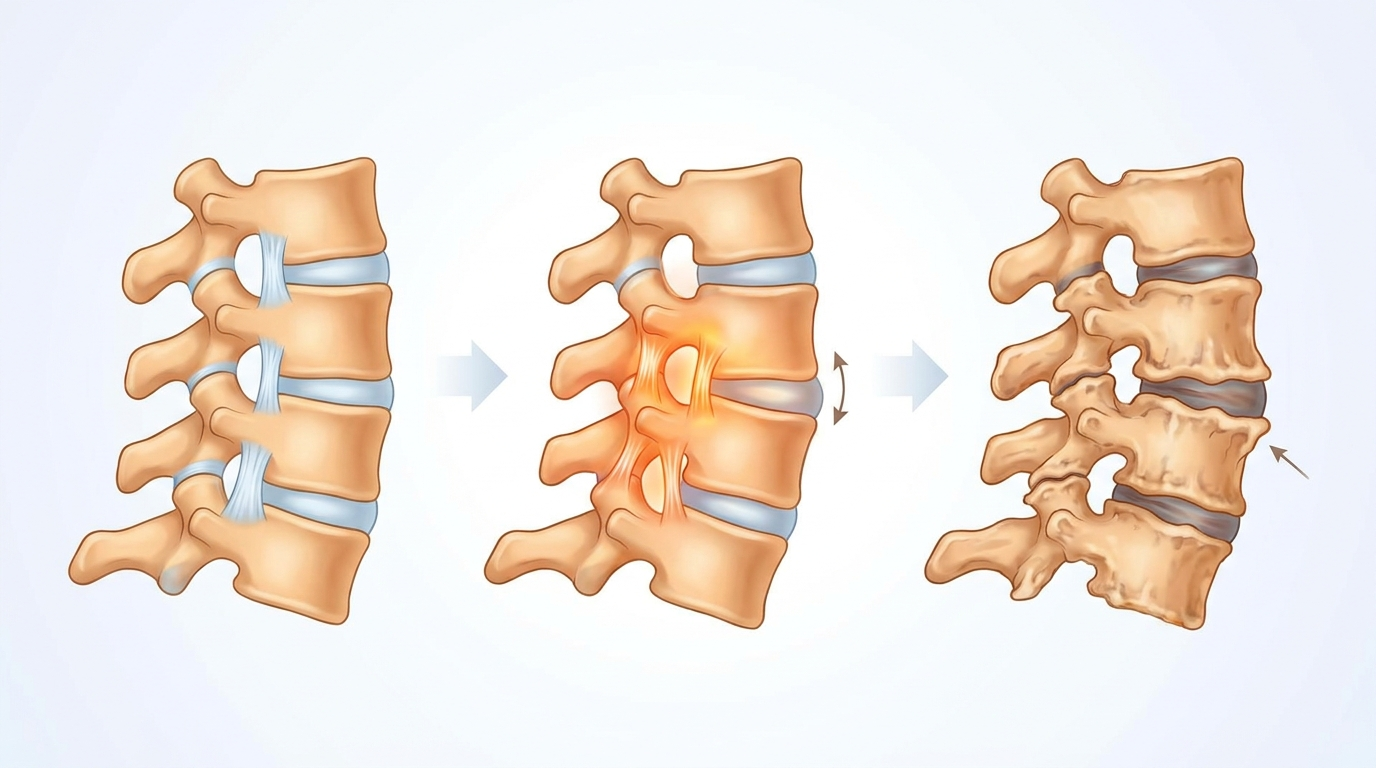
Illustration for education. Proprietary DMXRays anatomy — clinician-reviewed set in progress.
The body doesn't ignore a loose level
When a ligament has been over-stretched, the level it was holding starts moving too much. Your body notices. Muscles guard it first, then — over months and years — it lays down extra bone around the joint, trying to do the ligament's old job with a stiffer material. Those bone spurs aren't random bad luck; they're your body's repair plan for motion it couldn't control.
Why it gets called 'arthritis' years later
By the time degeneration shows on a still X-ray, the original injury is old news. The spurs and disc narrowing get labeled age-related wear — but one level being far more worn than its neighbors is the fingerprint of an old injury, not of birthdays. Age wears evenly; injury wears one address.
What motion imaging adds
A still image shows the bone-building result. A Digital Motion X-Ray shows the cause still at work: the level that slides or hinges too much while its stiffened neighbors barely move. Catching that pattern early — before the body finishes 'fusing' its own repair — is the window where correction matters most.
Symptoms it can cause
This is exactly what a Digital Motion X-Ray reveals.
A still X-ray is one frozen moment. DMX films your neck moving — so the affected level shows itself. Ask your provider about a Digital Motion X-Ray, or find a clinic that uses DMXRays.
Related
Educational and informational only — not medical advice or a diagnosis. Imaging must be interpreted by a licensed clinician. Powered by doctorhutcheson.com.